


Necessary cookies help make a website usable by enabling basic functions like page navigation and access to secure areas of the website. The website cannot function properly without these cookies.
15 Customer Service Tips for E-commerce That Actually Work in 2026
E-commerce customer service is harder than it looks. You're handling order questions, returns, complaints, and pre-purchase hesitation across live chat, email, WhatsApp, and social media, often with a small team and no call center. One slow response at the wrong moment and the sale is gone.
These 15 tips cover what actually moves the needle: from response time fixes you can act on today, to automation setups that reduce support tickets without reducing quality. Concrete advice, real examples, no fluff.
What Makes E-commerce Customer Service Different
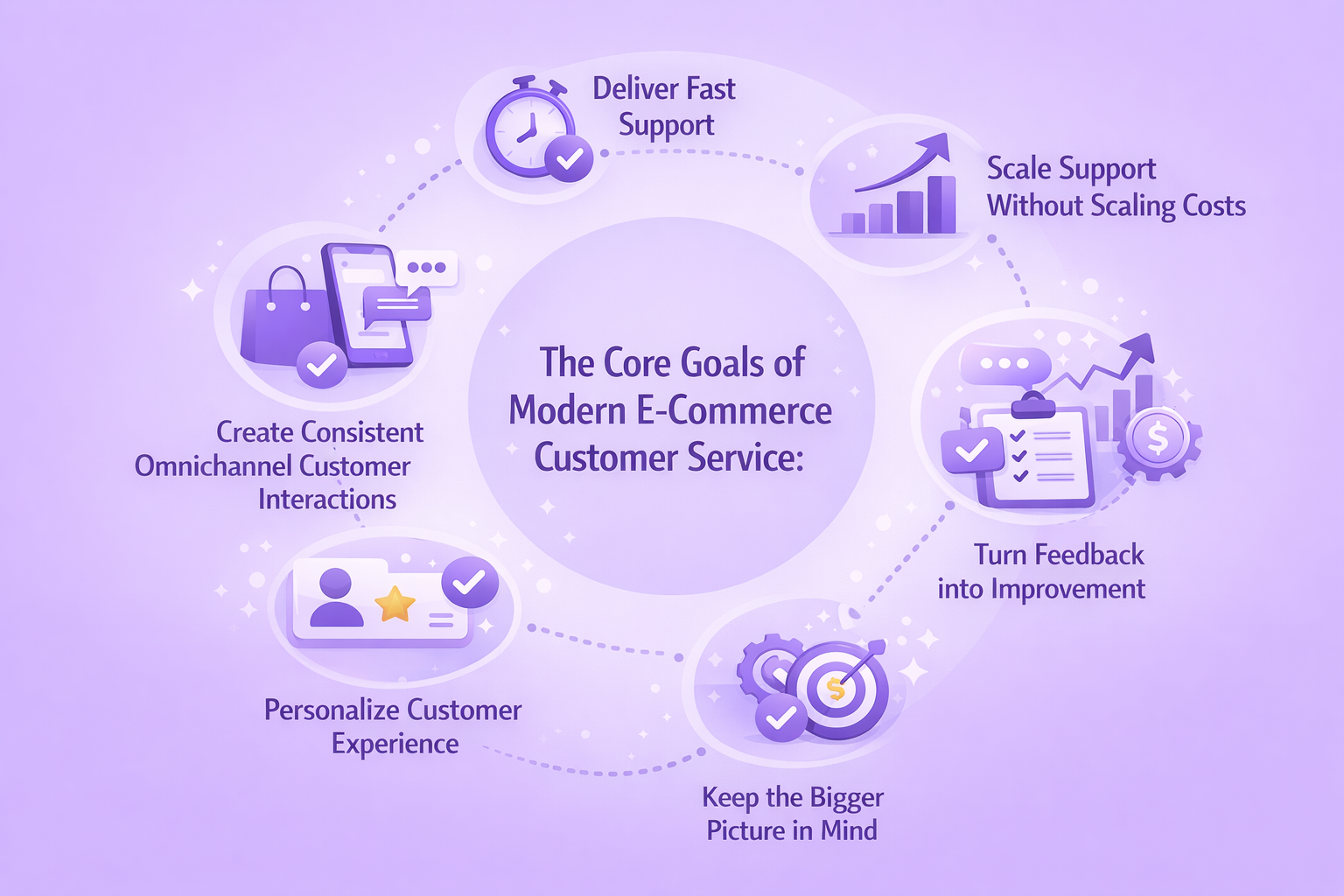
Customer service in e-commerce isn't the same as traditional customer support. You're not running a call center. You're managing customer interactions across digital channels: website chat, email, social media channels, and messaging apps, often 24/7, at scale, with high customer expectations and tight margins.
The brands that win don't just respond to customer complaints. They design the entire customer journey so fewer complaints happen in the first place. That shift from reactive support to proactive customer experience is what separates average stores from ones with strong customer loyalty and repeat customers.
Here's how to get there.
15 Customer Service Tips for E-commerce
1. Map Your Customer Journey Before You Fix Anything
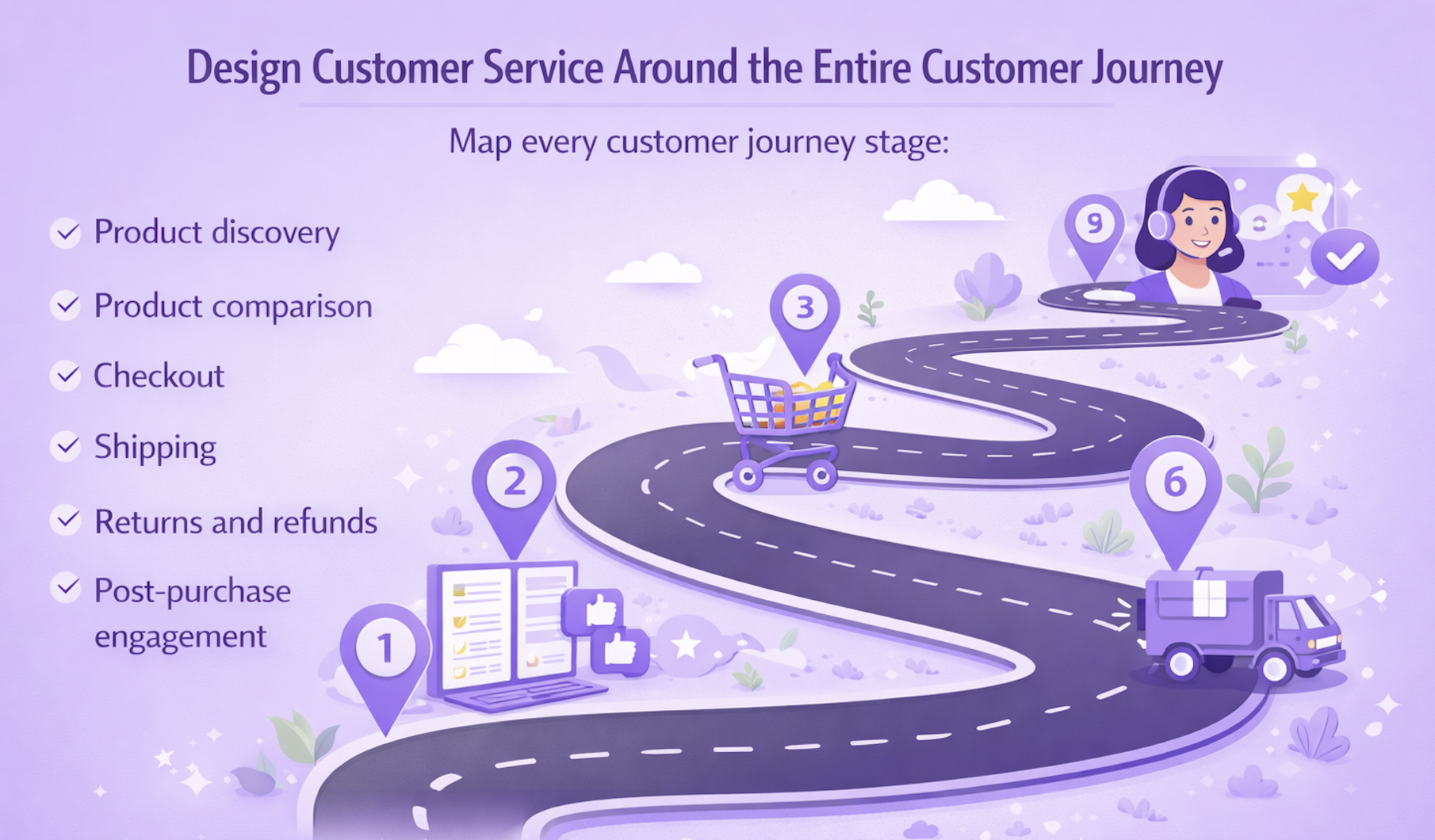
Before changing tools or hiring support agents, map every stage your customers move through: product discovery, comparison, checkout, shipping, returns, post-purchase engagement.
Where do customer complaints cluster? Which stages generate the most support tickets? That's where to start.
Quick win: Add a proactive live chat prompt at checkout. It's the highest-anxiety moment in the customer journey: a "Need help?" message at the right time prevents abandoned carts better than any discount code.
2. Respond in Under 2 Minutes or Lose Them
Speed is one of the most direct drivers of customer satisfaction. Customers contacting you via live chat won't wait. Industry benchmarks for e-commerce:
- Live chat: under 2 minutes
- Email: under 24 hours
- AI chatbot: under 5 seconds
- Social media: under 1 hour
If you're consistently missing these, response time is your highest-leverage fix before anything else.
3. Automate the Questions You Answer Every Single Day
Most e-commerce support teams spend 40–60% of their time answering the same frequently asked questions: "Where's my order?", "How do I return this?", "What's your refund policy?"
AI-driven chatbots handle these instantly: no queue, no wait, no human needed. That's not a nice-to-have. When 40–60% of your support tickets are repeatable, workflow automation gives you a huge competitive advantage.
Footshop implemented Amio's AI chatbot and achieved a 33% reduction in customer support costs while maintaining customer satisfaction scores.
4. Build a Knowledge Base That Actually Gets Used
A knowledge base is only useful if customers and your AI can find what they need in it. Most e-commerce brands build one and forget it.
Best practices:
- Write articles around real customer concerns, not internal categories
- Update content monthly based on what your chatbot couldn't answer (check the no-match rate; those are your gaps, ranked by frequency)
- Connect it directly to your AI chatbot so self-service support works automatically
A well-maintained knowledge base reduces repetitive customer interactions and takes pressure off your support agents for the questions that actually need a human.
5. Give Every Channel a Clear Response Standard
Omnichannel support doesn't mean being everywhere; it means being consistent everywhere. Customers expect the same answer whether they reach you via live chat, email, or social media.
Set response-time benchmarks per channel and share them with your team. Publish them on your contact page too. Managing customer expectations upfront reduces customer complaints downstream.
6. Use Customer Data to Personalise, Not Just to Say Their Name
Generic responses weaken customer relationships. Personalisation means referencing what the customer actually did: their order history, their previous customer interactions, the product they're asking about.
Your CRM systems and Customer Relationship Management tools make this possible. When support agents and AI chatbots have context, responses feel human rather than transactional. That's what builds customer trust.
Common mistakes to avoid:
- Sending the same automated reply regardless of order status
- Not referencing previous support tickets from the same customer
- Using the customer's name but ignoring every other piece of customer data you have
7. Set Up Proactive Shipping Updates Before Customers Ask
WISMO, "Where's my order?", is the single most common customer question in e-commerce. It's also the most preventable.
Set up automated order tracking messages at each shipping milestone: confirmed, dispatched, out for delivery, delivered. When customers know what's happening, they don't need to contact you. This alone can deflect 20–30% of inbound support tickets during peak periods.
8. Always Keep a Human Escalation Path
AI and automation handle the predictable. But trapping customers in a loop when they have a complex issue destroys customer experience faster than a slow response time.
The rule: every automated flow needs a clear, easy exit to a human agent. Route high-value customers, sensitive complaints, and anything the chatbot flags as unresolved directly to your customer success specialists. AI restructures human support; it doesn't replace it.
9. Respond to Negative Online Reviews Publicly
Online reviews are a customer touchpoint most brands ignore. When a customer posts a complaint publicly and gets no response, every future customer who reads it draws a conclusion.
Responding publicly, even to a one-star review, shows customer care and gives you a chance to demonstrate how you handle customer complaints. The response isn't for the unhappy customer alone. It's for everyone reading.
A simple complaint handling process: acknowledge, apologise without over-explaining, offer a direct resolution path (email or DM), and follow up.
10. Track CSAT Alongside Deflection Rate, Not Instead of It
Customer Satisfaction Score (CSAT) and ticket deflection rate measure different things. A high deflection rate with low CSAT scores means your automation is blocking customers, not helping them. A low deflection rate with high CSAT means you're over-relying on human agents for work AI could handle.
Track both. The target: high deflection, high CSAT. When they diverge, that's where to look.
Other key support metrics to monitor:
- First response time: speed of initial reply
- Resolution time: time to fully close the issue
- Customer Effort Score (CES): how hard did the customer have to work?
- Net Promoter Score (NPS): would they recommend you?
- Customer retention rates: are they coming back?
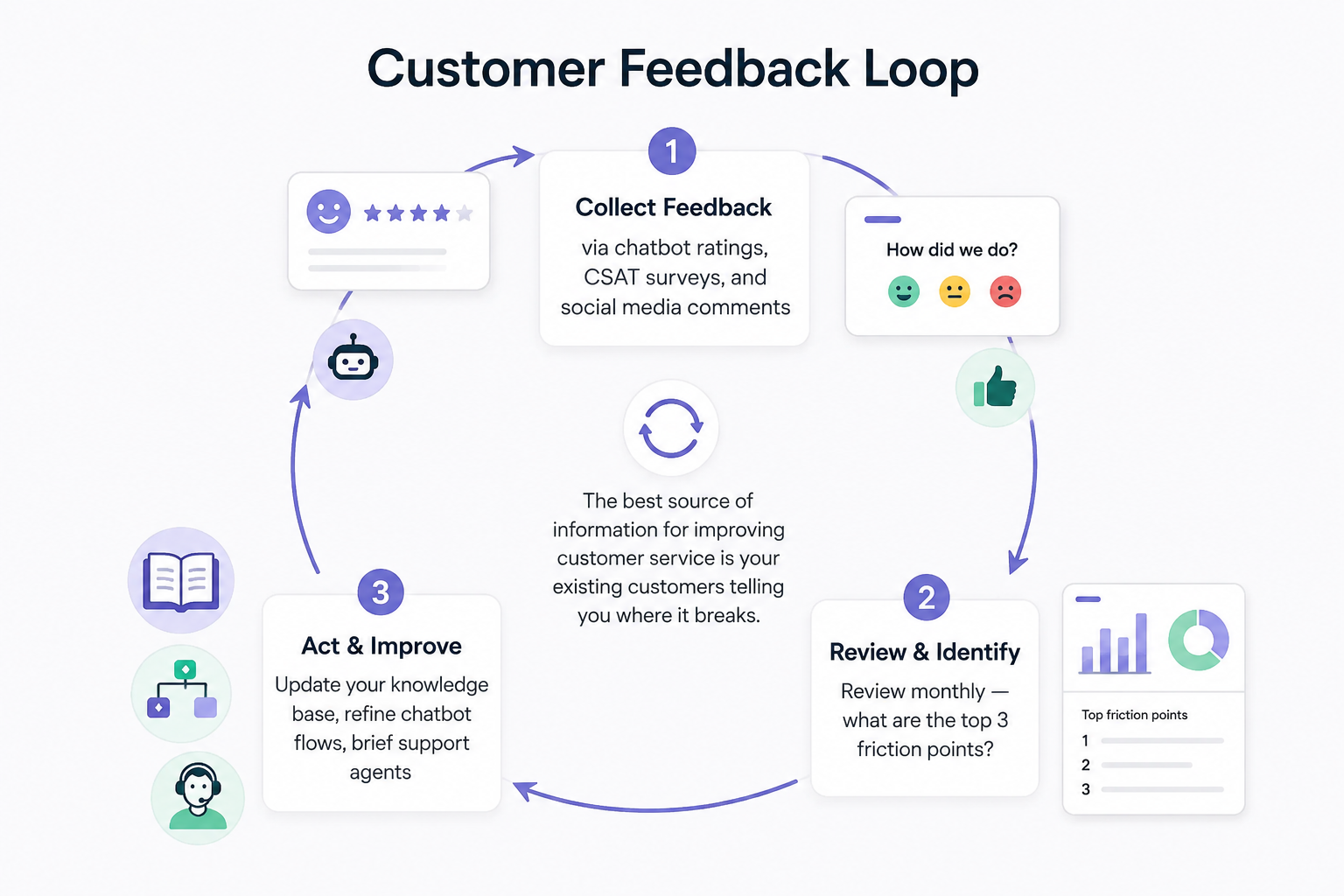
11. Collect Customer Feedback at Every Stage, Then Use It
Customer feedback is only valuable if it changes something. Most e-commerce brands collect it via CSAT surveys and post-purchase feedback forms and then do nothing with it.
Build a simple loop:
- Collect via chatbot ratings, CSAT surveys, and social media comments
- Review monthly: what are the top 3 friction points?
- Update your knowledge base, refine chatbot flows, brief support agents
The best source of information for improving customer service is your existing customers telling you where it breaks.
12. Train Support Agents on Tone, Not Just Process
Customer service skills aren't just about knowing the return policy. Active listening, clear communication, and the right tone under pressure are what turn a complaint into a retained customer.
For e-commerce specifically, train your team members on:
- De-escalating frustrated customers without offering unnecessary discounts
- Knowing when to escalate vs. when to resolve independently
- Writing responses that feel human, not like a ticketing system auto-reply
- Handling social media comments in brand voice
First impressions in customer interactions set the tone for the entire relationship. A scripted, robotic first reply signals that no one is really paying attention.
13. Personalise AI: Don't Just Deploy It
Smart chatbots trained on generic data give generic answers. The difference between a chatbot that helps and one that frustrates is how well it knows your specific products, policies, and customers.
Connect your AI chatbot to:
- Your product catalogue (so it can answer specific questions about items)
- Your CRM or Customer Profile System (so it knows the customer's order history)
- Your knowledge base (so it references your actual policies, not guesses)
Natural language processing has made AI-driven chatbots far better at understanding customer intent, but they still need your data to be useful.
14. Treat Your AI as a Product, Not a One-Time Setup
AI and automation tools are not "set and forget." Without ongoing monitoring, chatbot responses go stale, product knowledge gaps appear, and customer expectations shift.
Build a monthly review into your workflow:
- Check no-match rate (questions the bot couldn't answer)
- Review escalated conversations: why did they need a human?
- Update flows when policies, products, or common customer questions change
The stores getting the most from AI treat it like a team member that needs regular briefing, not a tool they installed and stopped thinking about.
15. Connect Customer Service Data to the Rest of the Business
Customer service sits at the intersection of every part of the business: it knows what's confusing about your product pages, which shipping partner causes complaints, which return policy drives customers away. That intelligence rarely reaches the people who can act on it.
Set up a simple process: monthly summary of top customer complaints and friction points shared with marketing, product, and operations. Customer retention rates improve when support data drives product and logistics decisions, not just support workflows.
The Tools That Make This Possible
None of this requires a large call center or enterprise contact center software. Most e-commerce stores handling this well are using:
- An AI chatbot connected to their product data and knowledge base for first-line support
- A helpdesk (Zendesk, Gorgias, Freshdesk) for managing escalated support tickets and support agents
- A CRM for customer base and personalisation
- A feedback form or post-chat survey for CSAT scores
The key isn't the stack; it's how well these tools talk to each other. Disconnected systems mean support agents working without context, AI chatbots giving wrong answers, and customers repeating themselves across channels.
Where to Start
You don't need to implement all 15 at once. Start with the tip that matches your biggest current failure:
- Too many repetitive tickets? → Tip 3 (automate the common ones)
- Slow response times? → Tip 2 and Tip 5 (set standards and use AI)
- High ticket volume, low CSAT? → Tip 8 and Tip 10 (check your escalation path and your metrics)
- Customers not coming back? → Tip 6, Tip 11, and Tip 15 (personalisation and feedback loops)
The stores that handle customer service well aren't doing everything perfectly. They've identified their highest-leverage problem, fixed it, measured the result, and moved to the next one.
Want to see what automating the first layer of customer support looks like for your store? [Book a 30-minute demo with Amio]
E-commerce customer service is harder than it looks. You're handling order questions, returns, complaints, and pre-purchase hesitation across live chat, email, WhatsApp, and social, often with a small team and no call centre. One slow response at the wrong moment and the sale is gone.
This guide covers 15 specific things you can do to improve it: from response time fixes you can implement today, to automation setups that reduce ticket volume without reducing quality. Concrete tips, real examples, no fluff.
Common Mistakes + How to Fix Them?
E-commerce stores can automate many processes and implement tools, but without the right strategy, these tools can hurt the customer experience rather than improve it.
1. Over-Automating Without a Human Escalation Path
AI-driven chatbots are powerful, but they shouldn’t trap customers in endless loops.
One of the biggest mistakes is failing to provide a clear path to human support. When customers with complex issues can’t reach a real person, customer satisfaction drops quickly.
Best practice:
- Always include seamless escalation to human agents
- Route high-value or sensitive cases to customer success specialists
- Use generative AI to assist agents - not replace them entirely
2. Building a Knowledge Base That No One Uses
Many companies create Knowledge Bases but fail to optimize them.
Common issues:
- Outdated knowledge base articles
- Poor search functionality
- Disconnected systems that don’t integrate with chatbots
3. Ignoring Customer Data and Personalization
Generic responses weaken customer relationships.
Modern customer service depends on using customer data from your Customer Relationship Management system or Customer Profile System. Without personalization, even fast support feels transactional.
Mistakes include:
- Not referencing purchase history
- Ignoring previous customer interactions
- Sending one-size-fits-all automated replies
4. Measuring the Wrong Metrics
Some businesses focus only on reducing ticket volume or increasing chatbot containment rate.
While efficiency matters, ignoring customer satisfaction scores, customer retention rates, or qualitative customer feedback can create hidden problems.
For example:
- A high automation rate with low CSAT indicates friction
- Fast resolution time doesn’t matter if the issue returns
5. Failing to Continuously Optimize AI Systems
AI and generative AI tools are not “set and forget.”
Without ongoing monitoring:
- Chatbot responses become outdated
- Product knowledge gaps appear
- Customer expectations shift
Conclusion
Brands that win today don’t rely solely on traditional call center models or reactive customer support. They design systems that span the full customer journey, invest in structured Knowledge Bases, use customer data intelligently, and continuously improve based on customer feedback.
Most importantly, they combine human expertise with AI-powered chatbots and generative AI to deliver fast, personalized, and scalable service. Automation handles repetitive tasks. Human teams focus on complex, high-value conversations. The result is better customer relationships, higher customer satisfaction scores, and stronger customer retention rates.
Table of Contents
Start building AI chatbots with Amio.
Book a 30-minute session where we will find out how AI bot can help you decrease call center costs, increase online conversion, and improve customer experience.
Book a demoWhat is Amio?
We understand your business on
Book a 30-min consultation session where we will discuss your support cost optimization potential, experience improvements, including our online conversion increase techniques
Request a demo