


Necessary cookies help make a website usable by enabling basic functions like page navigation and access to secure areas of the website. The website cannot function properly without these cookies.
AI in E-commerce: How It Actually Works in 2026 (With Real Examples)
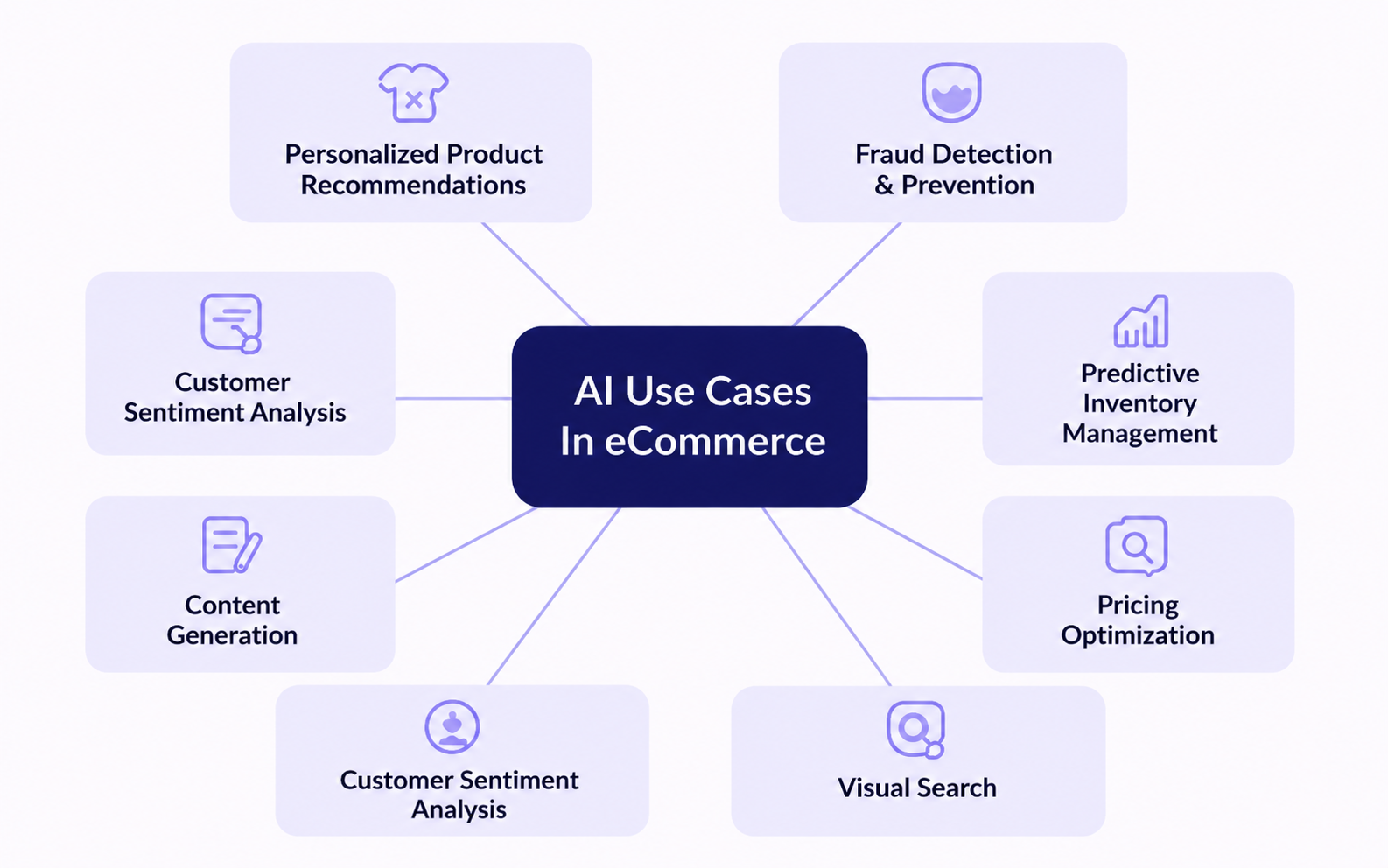
Everyone's talking about AI in e-commerce. Most of that conversation is either breathless hype or a list of features you can't actually evaluate. The reality is more useful: a handful of AI applications are genuinely moving the needle for online stores right now, and the rest are either overhyped, early-stage, or only relevant at enterprise scale.
This article covers the 8 that actually matter — what they do, where they work, and what a real implementation looks like. If you're an e-commerce operator deciding where to start, that's the framing you need.
AI Applications in E-commerce: Key Use Cases
AI is changing the digital marketplace in many ways. These are practical and impactful solutions for businesses to enhance customer engagement and operations. Below are some of the most significant use cases of AI in e-commerce.
1. Personalized Product Recommendations
AI-powered personalized product recommendations enable e-commerce businesses to offer relevant product suggestions to individual customers. The engine is simple: the more a customer browses and buys, the better the recommendations get. What makes it powerful is the scale — AI can do this with millions of customer data simultaneously.
This can enhance the customer experience by presenting item selections that feel tailored, leading to a more efficient and personalized shopping journey.
For businesses, personalized recommendations are a powerful tool for increasing average order values through upselling and cross-selling. They also facilitate product discovery, helping customers find items they might not have otherwise encountered.
Real life application: For example, you may have noticed online retailers like SHEIN utilize AI to dynamically tailor product recommendations based on real-time user behavior and interests.

2. Conversational Commerce & AI Assistants
AI-powered chatbots and virtual assistants are transforming customer support by providing instant, 24/7 assistance.
They handle a wide range of tasks, including answering frequently asked questions, guiding customers through the purchase process, tracking orders, sending reminders for abandoned shopping carts, and initiating returns. The main benefits for e-commerce businesses are less work for human customer service teams, better operational efficiency, and happier customers because of quick and steady support.
Real life application: 22% of Datart's requests were deflected to automated channels using Amio.
Generative AI has advanced these capabilities, allowing for contextually relevant responses that closely mimic human interaction. This leads to higher customer interactions and conversion rates.
Based on Deloitte, during Black Friday 2024, online retailers using AI chatbots reported a 15% increase in conversion rates.
3. Fraud Detection & Prevention
Online stores lose $48 billion a year to fraud. AI catches the patterns humans miss (unusual purchase sequences, mismatched shipping addresses, device changes mid-session) before the damage is done.
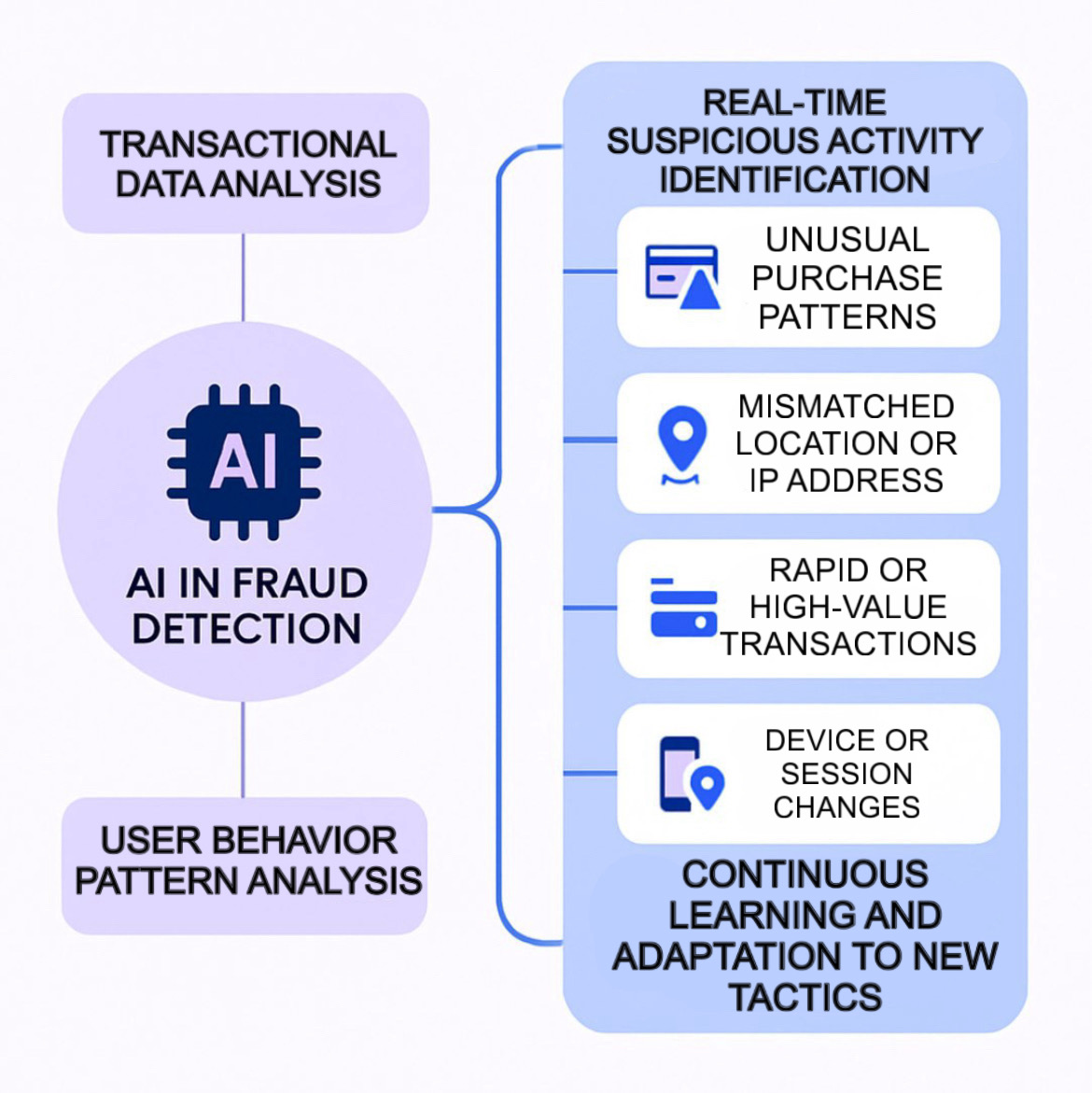
Real life appliation: Companies like Visa are using artificial intelligence and machine learning such as risk scoring to counter fraud.
4. Predictive Inventory Management
Inventory management can be tricky. Order too little, and you lose sales. Order too much, and you waste money. AI looks at sales history, promotions, website traffic, and even the weather to enable precise demand forecasts. This helps with real-time inventory management, including avoiding both stockouts and overstocking. It also reduces storage costs and helps free up cash. The freed-up capital can then be reinvested in the business.
5. Pricing optimization
In the competitive e-commerce environment, pricing strategies must be responsive to market changes. AI-powered dynamic pricing enables businesses to adjust product prices in real-time, optimizing revenue and profitability. This involves continuously analyzing factors such as current sales and demand forecasting, customer behavior, competitor pricing, inventory levels, and external events like holidays or promotions.
Dynamic pricing means your prices move in real time based on demand, competitor stock, and inventory levels. When a competitor runs out of a popular item, your AI raises your price automatically. When you're sitting on excess stock, it drops.
This allows businesses to maximize revenue by adjusting prices upwards during periods of high demand or low competitor stock, and downwards during slower periods to stimulate sales and clear inventory.
Research shows that dynamic pricing also enhances competitiveness by ensuring offerings remain attractive and responsive to market trends, preventing lost sales due to mispricing.
For instance, if a competitor experiences a stockout of a popular item, an AI system can detect this and automatically increase your price for that item, capitalizing on the market opportunity. Conversely, if a product is underperforming, AI can recommend or implement a price reduction to boost demand.
Real life application: Amazon uses AI to adjust prices for millions of products every 10–15 minutes based on user behavior, competitor prices, and supply/demand.
6. Visual Search
Sometimes, people don’t know how to describe what they want. That’s where visual search helps. Shoppers can upload a photo or use their phone camera. The AI then analyzes the product attributes, such as colors, patterns, shapes, and textures, and matches them with similar products within an e-commerce store’s inventory.
Real life examples: Platforms like Pinterest and Google Lens are prominent examples of visual search in action, allowing users to find similar products with image recognition.
This intuitive approach removes the need for precise descriptive keywords, making product discovery more accessible and engaging. For e-commerce businesses, integrating visual search enhances the browsing experience, particularly for visually driven industries like fashion and home decor. This leads to increased product discovery, reduced friction in the shopping journey, and improved conversion rates.
Bonus: Wayfair has taken this to another level by launching "Muse". This is a visual browser where users can plug in a prompt, from generic to highly specific. The search then generates a series of inspirational photos or scenes, each of which includes a number of recommended items from Wayfair’s catalog that users can either buy right then or add to a collection for purchase later.

7. Content Generation
Content creation in e-commerce, coming up with product descriptions, marketing copy, and visual assets, can be very time-consuming. Generative AI offers a solution by automating this process. This includes writing SEO-friendly product descriptions in multiple languages, crafting persuasive advertising copy, and generating personalized emails and SMS messages for marketing campaigns.
The automation of product description writing alone can save significant time and effort for businesses with large inventories. Beyond text, generative AI can also create lifestyle or hero images for product catalogs and social media, ensuring visual consistency and brand alignment.
This all means faster listings, consistent branding, and better SEO while enhancing conversion rates.
Real life application: Ebay has integrated generative AI tools to help sellers generate high-quality listings with better titles, descriptions, and structured data - just from a photo or basic input.
The risk is obvious, AI-generated product descriptions tend toward the generic unless you give them strong input. The quality ceiling is your brief, not the model
8. Customer Sentiment Analysis
To grow, you need to know what your customers think. AI deep sentiment analysis scans reviews, social media, and support chats to find out how customers feel.
Basically, if 200 reviews in a week mention slow shipping, sentiment analysis flags it before your support team has time to notice the pattern.
Benefits of AI for your E-commerce
Benefit | What it means in practice |
|---|---|
Better customer experience | Personalized recommendations + 24/7 AI support |
Lower operational costs | Automation reduces manual tasks across support and content |
Smarter inventory | Less overstock, fewer stockouts |
Higher conversion | Dynamic pricing + visual search reduce friction |
Fraud protection | Real-time detection before losses occur |
Faster content | AI handles product descriptions at scale |
Read more: See our top 25 e-commerce integrations for automizing your shop.
Conclusion: AI as a Strategic Partner for E-commerce
The e-commerce stores making real gains from AI right now aren't using all eight of these simultaneously. They've picked one or two, usually customer support automation and personalized recommendations, gotten them working, and built from there.
If you're starting from scratch, conversational AI is the highest-leverage first move. It's the use case with the clearest ROI, the fastest setup time, and the most direct impact on customer experience. See how Amio handles it.
Table of Contents
Start building AI chatbots with Amio.
Book a 30-minute session where we will find out how AI bot can help you decrease call center costs, increase online conversion, and improve customer experience.
Book a demoWhat is Amio?
We understand your business on
Book a 30-min consultation session where we will discuss your support cost optimization potential, experience improvements, including our online conversion increase techniques
Request a demo